
Trappist
Beer brewed within monastery walls under the monks' supervision, only a handful of breweries worldwide may carry the label. Profits go to the abbey and charity.
Try here: Westmalle Dubbel, La Trappe Blond, Orval (bottle)
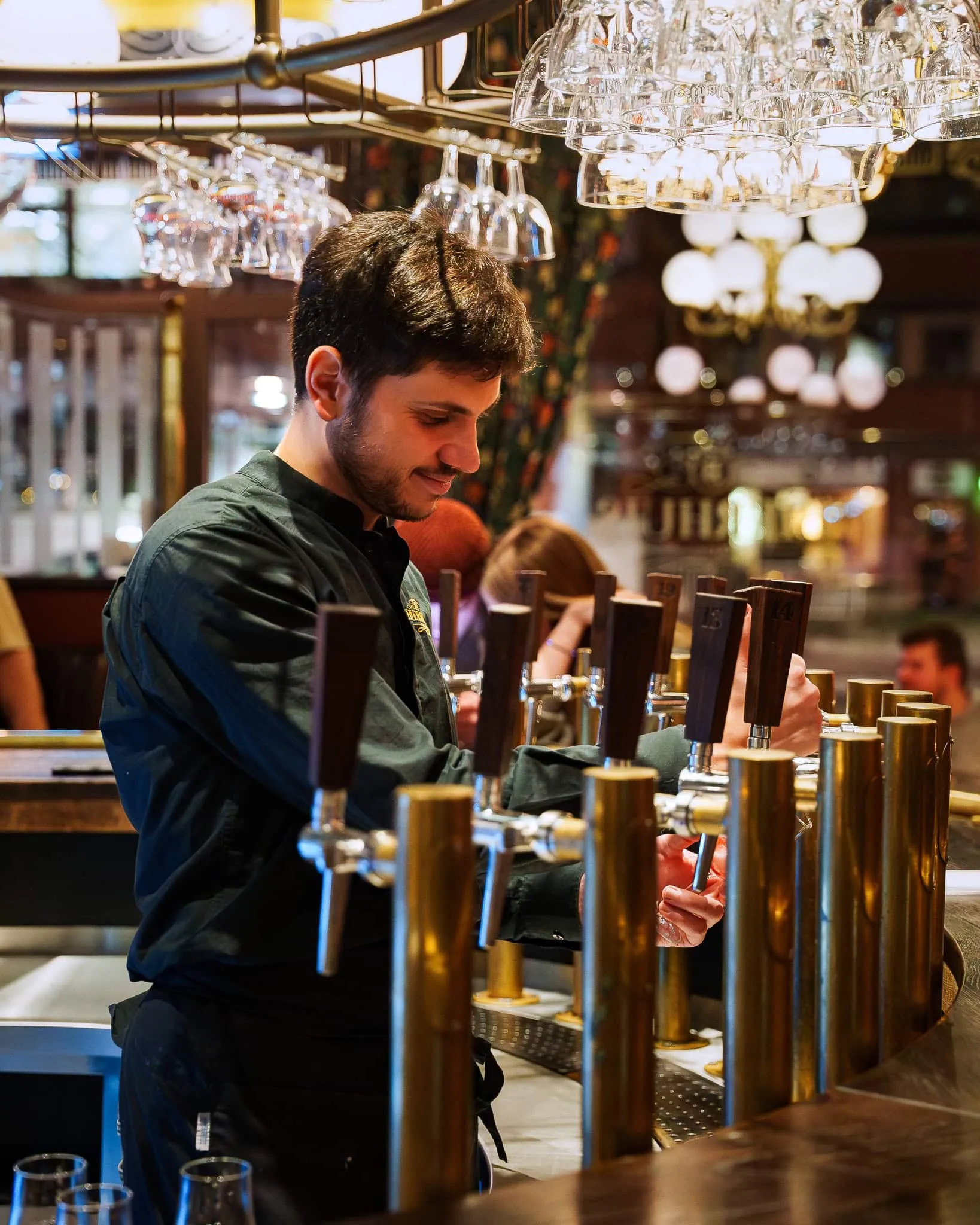
A little course at the bar
Belgium has more beer styles than any other country, and its own glass for nearly every beer. Here's everything you need to navigate our 24 taps and 100+ bottles.
Beer brewed within monastery walls under the monks' supervision, only a handful of breweries worldwide may carry the label. Profits go to the abbey and charity.
Brewed in the monastic tradition but outside the walls, often under licence from an abbey. The same styles and depth, dubbel, tripel, blond.
The abbey's everyday beer, the low-strength 'patersbier' the monks drank with meals. Pale, low in alcohol and rarely sold outside the walls.
Dark and malty, 6-8%. Raisin, caramel, dark bread and chocolate. The name 'dubbel' comes from the old abbey habit of grading beers by strength, by one common account marked with chalk crosses on the casks, one for the weakest. The modern style was born at Westmalle, whose 1856 dark beer took its present recipe in 1926.
Golden and strong, 8-10%, yet deceptively easy to drink. Fruity yeast, spice and a dry finish. 'Tripel' was the strongest grade in the abbey scale, and it was Westmalle that brewed the first modern tripel in 1934.
The strongest grade, usually around 10% and dark, with dark fruit, caramel and a warm finish. The name was coined by the Dutch abbey La Trappe for its Quadrupel in 1991.
Unfiltered wheat beer spiced with orange peel and coriander. Saved from extinction by Pierre Celis, who revived it in Hoegaarden in 1966.
Belgium's signature: pale colour, big aroma, high strength. Duvel defined the style, 'a real devil'.
Spontaneously fermented beer from the Senne valley west of Brussels, one of the world's oldest surviving beer styles, fermented by wild yeast from the air. Gueuze and kriek are its children: gueuze blends young and old lambic and referments in the bottle, kriek is lambic aged on sour cherries.
Unlike lambic, this sour is fermented with cultured yeast and then soured by lactic bacteria in giant oak foeders for up to two years. Vinous and tart, 'the Burgundy of Belgium'.
our head chef's quick guide
In Belgium the glass is part of the beer. Tulip glasses concentrate the aroma of strong blond ales, chalice glasses let lambic's acidity breathe, and Kwak's famous coachman's glass with its wooden stand dates back to the Napoleonic era. Breweries design glasses to lift precisely their beer, the right foam, aroma and temperature.
That's why you'll find dozens of different glasses on our shelves, and why every beer here is always served in its proper glass. It genuinely tastes better. Skål, or as they say in Flanders: santé!